Advantages
- The most advanced open source database, reliable for over 35 years
- No cost tied to stored volume or queries
- Full reversibility: can be hosted anywhere
- A single technology to master for data and AI
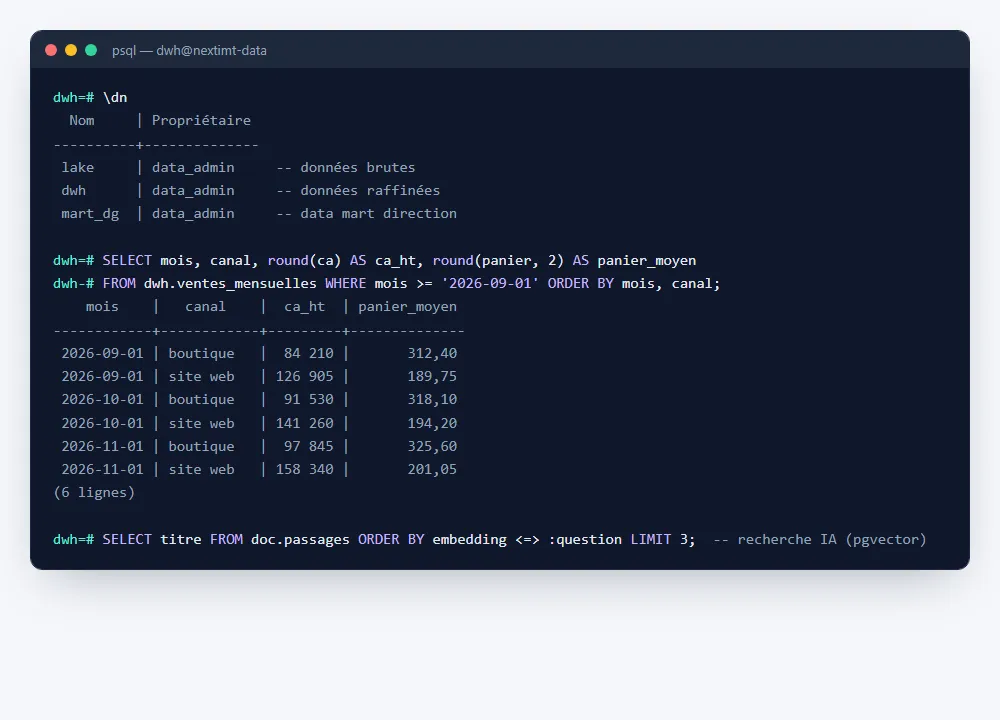
PostgreSQL stores your raw data (data lake), your refined data (data warehouse) and your business data marts. With the pgvector extension, it also keeps the vectors used by AI.
Screenshots of PostgreSQL in use. Click an image to enlarge it.
Every building block in our architecture is replaceable. Here are the main alternatives we studied.
Very fast columnar database for massive analytics.
Lightweight analytical engine, ideal as a complement.
Cloud warehouses billed for compute and storage.
Information updated at the end of November 2026. AI and data technologies move very fast: we may have changed our minds since.
Hesitating between several solutions, or already using another tool? Let's talk.