Confidentiality
Can run on your own infrastructure so you keep control of your data flows.
Six interconnected open source building blocks covering the whole value chain: from business knowledge to the interface your teams use, with full monitoring.
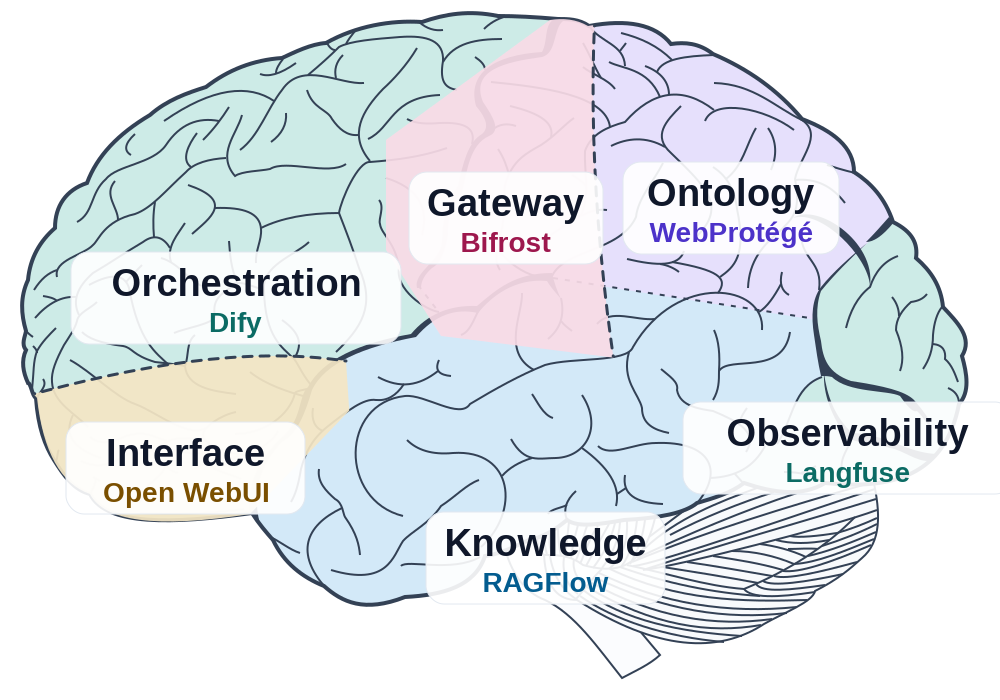
Employees chat with their assistants in a simple interface, with access rights per business profile.
Workflows and agents run the configured steps, querying authorised knowledge and tools (ERP, OMS, e-commerce, customer service…).
Your documents are extracted, chunked and indexed so the AI answers from your sources, with references.
Experts formalise concepts, products and business rules; the ontology structures the knowledge used by the AI.
A single entry point to local or cloud LLMs: routing, failover, quotas and usage tracking.
Traces, costs, latency, prompt management and user feedback to manage quality continuously.
Your data stays yours. Every technical choice is driven by confidentiality, cost control and your independence from vendors.

Can run on your own infrastructure so you keep control of your data flows.
No per-user licence on the stack; usage budgets and caps per team.
Multi-model: switch LLM provider without rebuilding your use cases.
Human sign-off on binding decisions, role-based access, audit logging.
System inventory, AI Act risk analysis and GDPR by design.
From a simple assistant to tool-using agents, the stack grows with your use cases.
We choose the right level of integration with you, and check the value delivered before automating further.
Writing and ideation on non-sensitive data.
An approved workspace, managed accounts and clear rules.
Tested, reusable prompts for consistent results.
RAG on your documents, with sources and access rights.
AI embedded in your processes, with controls and manual fallback.
Agents that carry out actions under supervision.
We also compare integrated alternatives (Microsoft Copilot Studio, Amazon Bedrock, Mistral AI Studio, Dust…) against your constraints.